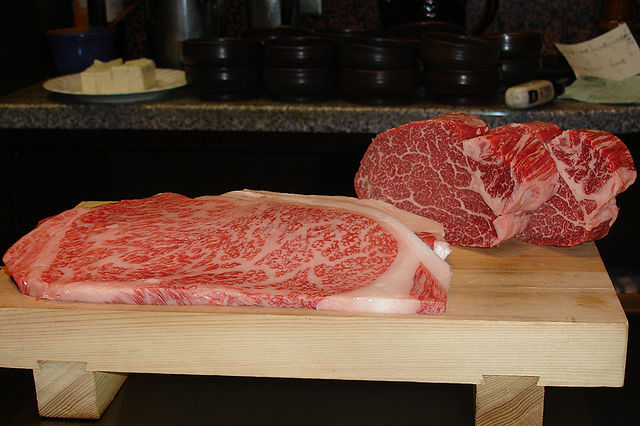
黑~~我们花这么多钱去吃我们那么崇拜的Kobe肉。。。结果就是冒牌的Ebok肉~
其实好吃就行了。
其实好吃的就行了,不需要那么贵是吧?
那咱可以去的地方太多了?
纵使是意外之财,花去买本土假Kobe,一家吃个500-800美元,我也不情愿。。
So without further ado:
1. What is real Kobe beef? Under Japanese law, Kobe beef is a very specific product made in one place, from one breed of cattle, under many very strict rules, which I describe in detail in Part One. Kobe beef and related terms and practices are protected in Japan by both trademarks and patents. These facts are contrary to what several readers, especially those representing U.S. breeders, have tried to paint Kobe as: a generic term referring to a “style” of Japanese beef. This is simply not true. Kobe beef is akin to real champagne. There are other excellent sparkling wines in France, but they are not champagnes, and there is other excellent beef in Japan, but it is not Kobe beef.
2. Why do you say “real” Kobe beef? Because the Japanese patents and trademarks are not recognized in the U.S., leaving producers here, and importers from places like Australia and South America, to slap the Kobe name on a wide variety of beef – and in some cases pork -products. To me real Kobe beef is that made under Japanese law, from Hyogo prefecture in Japan, of which Kobe is the capital.
3. Is Kobe beef the best? Probably not, though matters of taste are always subjective. Despite what some readers took away, I never said Kobe beef was the best beef available, in the world or in Japan. In fact, I said quite the opposite, that other regional Japanese beef is considered better by many experts and by many Japanese diners. Also, Japanese premium beefs like Kobe have a unique style not everyone likes. I am personally a big fan of American beef, Italian beef, and Scottish beef. My point isn’t that Kobe beef is some sort of culinary Holy Grail, only that it is a very particular thing that is not sold in the U.S., despite appearing widely on menus here.
4. Do you mean Kobe beef is not exported to the U.S.? No it is not. And neither is any other Japanese beef currently. For nearly two years all Japanese beef, fresh or frozen, whole or cut, boned or on the bone, has been banned by the USDA due to an outbreak of foot and mouth disease. UPDATE: There was a dramatic change to the USDA’s rules for Japanese beef importation on August 27, 2012 which is not reflected in this article. I have posted an up-to-date follow piece explaining the change and current situation here.
Even before this it is highly questionable whether any real Kobe beef was allowed for import into the U.S., and other Japanese beef was often passed off as Kobe. For information on Kobe beef in Canada, Click here.
5. I see “Domestic Kobe” or “American Kobe” on menus. What does that mean? Very little. It is impossible to generalize since this is largely unregulated. Farmers could be using the same cattle breed as is used for Kobe beef in Japan or any of many other things. Give this definition the same respect you would give to American Scotch Whisky or American Champagne, neither of which you would be likely to pay a premium for.
6. What about Wagyu? I see that a lot. What does it mean? Literally Wagyu means “Japanese cows.” Beyond that, its definition gets vaguer depending who you ask and what country you are in. It could be taken to refer to all cows in Japan, including the Western and European breeds with which we are familiar, but it is most commonly used to refer collectively to all historically Japanese breeds, of which there are four major ones. Many U.S. ranchers, and the Executive Director of the American Wagyu Association, wrote in to insist that Wagyu is a breed, but I have found zero evidence to support that argument, and lots to refute it. Nonetheless, many farmers and especially wait staff insist on calling it a breed. Further, many say emphatically that it is the same breed as Kobe beef. This is not true. The cattle used for Kobe beef are a form of Wagyu yes, just as Cabernet Sauvignon is a form of grapes. But not all grapes are Cabernet, and not all Wagyu is Kobe. However, as I said in Question 3 above, Kobe is not necessarily the best, and in Japan, other forms of beef, and other breeds of Wagyu, are sometimes considered superior. All of the four major Japanese breeds generally lumped under the Wagyu umbrella are considered high quality.
|
 楼主: 语婷
 [复制链接]




 楼主
楼主




 太强了,还有考级自测分数呢~









 发表于 2013-10-15 03:46:15

 发表于 2013-10-15 10:26:03


 俺还等着一起去吃呢。